Thursday, June 9, 2011

Safety is Always in Fashion


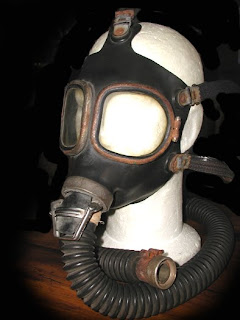
This mask is dated in the 1920’s and was used for miners. Here this mask exhibits a much more striking alien feel with the tube attachment.

The 1940’s British gas mask is accompanied with an olive green infantry bag. During WW2, the gas mask would have been used by soldier to protect themselves against weapons of war.

This final mask is modern day and is accompanied by a pair of safety glasses. The use of this mask is that of a renovation, where a lot of dust was entering the air due to sanding and construction.

These safety precautions taken over history show a progression of technology and safety and an evolution of these masks through time.

Bridget Swift
Strawbery Banke Curatorial Intern

Shoe Gallery - 1820s edition


These examples demonstrate two different styles of shoes that were worn in the 1820s. The first is a pair of wool slippers (c. 1825), decorated with brightly-colored petit point stitches. These heel-less types of shoes were popular among the young and fashionable at the end of the 18th century, and remained in vogue until the beginning of the Victorian period. The style, if not the decoration, of this pair is strikingly modern - not far from the "ballet" shoes worn by young women today. A brightly colored patchwork pair by Emma Hope clearly demonstrates this 21st-century twist on an old idea.


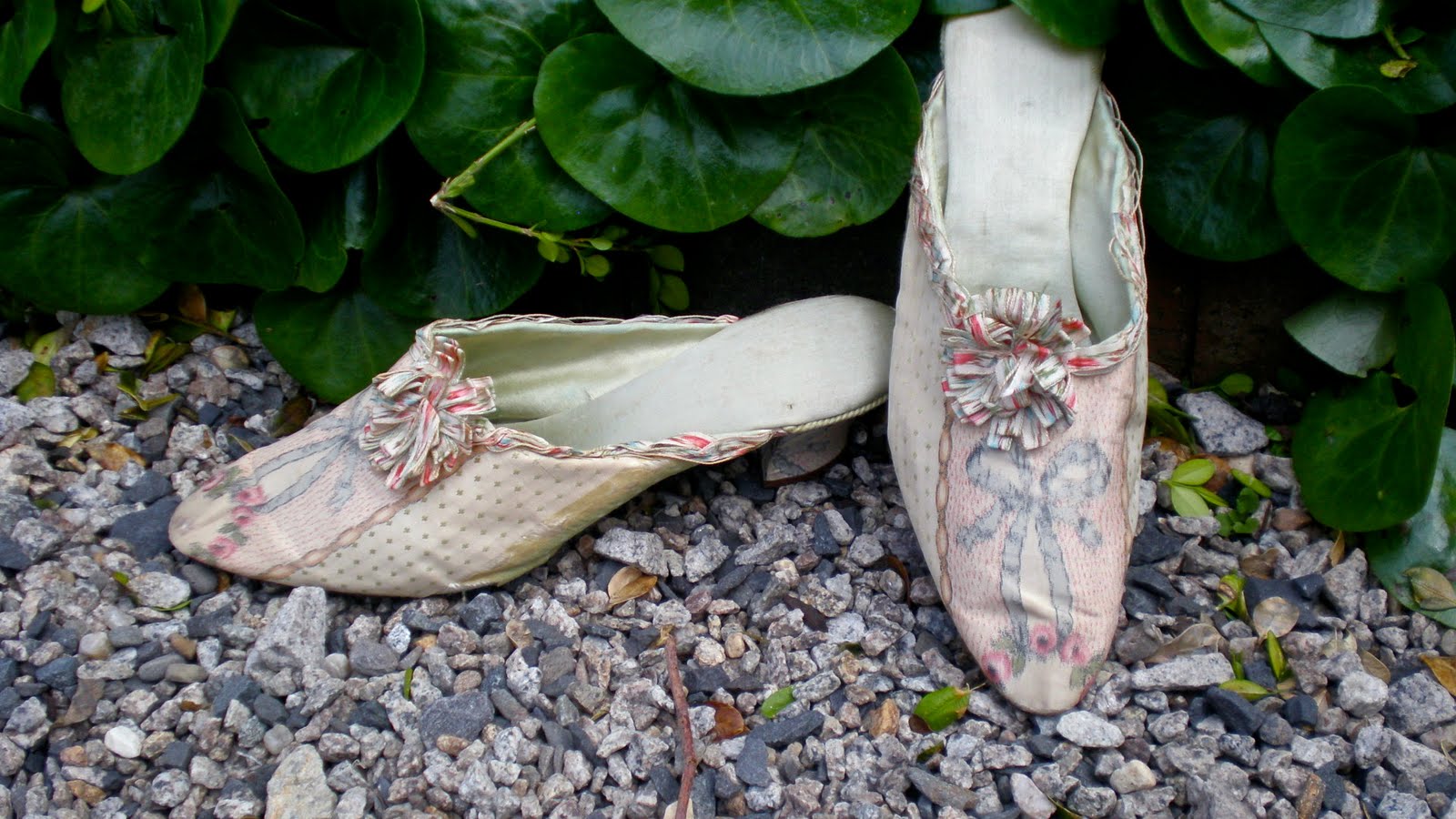
The second is a pair of c. 1820 mules - shoes with raised heels but open backs. Similar shoes were worn in the 1700s as well, but the patterned silk of this pair is more in line with the neoclassical style of the first decades of the 19th century. The padded silk under the wearer's foot must have been wonderfully comfortable - a pair in a different fabric might still be appealing today!


Alexa Price
Strawbery Banke summer curatorial intern

Strawbery Banke shoes photographed on site by Alexa Price
Emma Hope shoe from www.emmahope.co.uk

Shoe Gallery - 1785 and today

The Carter Collections Center at Strawbery Banke houses many pairs of shoes as part of the costume and textile collection, including these two examples from c. 1785.

The first pair, constructed from kidskin leather and partially covered in ivory satin, remains in beautiful condition for its age. Markings inside the shoe tell that it was made by Chapman Bootmakers of London, and worn in Portsmouth by "Mrs. Windslow Peirce" (of a local family. There is also an early, probably original monogram "MCB"). A close-up photograph shows the front design of the shoe - the satin covering and binding, a pointed piece or "tongue" that extends over the top of the wearer's foot, and a complex bow edged with looped fringe. The side view shows a narrow heel, with the characteristic curves of the 18th century. It is easy to imagine such an exquisite piece of footwear for a wedding, even 200 years after the shoe was worn. Well known London shoe designer Emma Hope, who is currently designing a line of shoes and matching bags inspired by the Strawbery Banke Museum collection and is a member of the "Thread" design team, recently included similar features in a shoe for her wedding line - ivory satin, a bold front bow of grosgrain ribbon, with small narrow heels. They look as elegant in 2011 as they must have in the 1780s "


The second pair, less sturdy and constructed of pale yellow figured silk, were worn by Lydia Waite Williams of Salem, Massachusetts, and were a recent gift to Strawbery Banke. Miss Williams' shoes tend to wrinkle and fold due to previous storage conditions, but when new, the shape would have been similar to Mrs. Peirce's. The front bears the same pointed "tongue," a similar binding pattern, and little noticed "drawstring." The heel is equally narrow and sweeping, although shorter than the Peirce shoes. Miss. Williams' shoes are decorated in the front with sequins and beads, in a design that creatively suggests the buckle closure of other period shoes-- a trompe l'oeil effect as observed by Paula Richter, Peabody Essex Museum."


Alexa Price
Strawbery Banke summer curatorial intern

Strawbery Banke shoes photographed on site by Alexa Price
Emma Hope shoe from www.emmahope.co.uk
4H Design Revue Teaser- Historic Reproductions


I recently had the honor of taking part as a judge in the University of New Hampshire Extension Program 4H Design Revue. Youth designers from age 12 to 18 from throughout New Hampshire took part and created some stunning and inspired creations for their own uses: proms, hanging out with friends, first communion, attendance at conferences, family gatherings and so on. Overall the tailoring was impeccable, frequently with complex darts, zippers, fastners of every sort, seams, and pleats. These young men and women are type A personalities in the making and should be applauded for their efforts. Their families and leaders, and the UNH Extension Program are to be highly commended.

More on this important educational and outreach program in future blogs, but I wanted to share a few examples of youth excellence in design and artistry in the Granite State. Being part of the process was personally and professionally fulfilling and I encourage others with an interest or avocation to volunteer for any number of programs. To Janith Bergeron, of The Sewing Tree, and Kathy Jablonski, Grafton County Extension program, I extend my thanks for their warm hospitality and experienced guidance.

Top:
Deanna in Elizabethan multi piece garment. The lavish floor length robe, with gold trim braid and period appropriate closures, and the bodice "bustier" with finely constructed boning set this stunning reproduction piece apart. It took weeks to construct, fabricate and tailor, and including some hand sewing.

Sarah's blue silk Empire waist, ankle length gown uses period appropriate seams and subtle detailing such as lace edged sleeves. She demonstrates that an elegant style never goes out of style even after two centuries!

Sunday, May 29, 2011

Comprehensive fashion site


This is a really interesting site - could get lost in it for ... on Twitpic

http://www.fashion-era.com/

Royal Ascot approaches: summer hats & wedding bonnets


With Royal Ascot approaching, we are thinking about hats, hats and more hats. We have dusted off some of our favorites and brought them out (briefly) from storage.

Top to bottom: Green silk bonnet worn by Bridget, Goodwin Mansion, 2010; "Wimsey" worn by Bridget, Leonard Cotton's Tenant House, 2010; "My Wedding Bonnet" 1878; Classic straw hat with green ribbon worn by Tara, Thomas Bailey Aldrich Garden, 2010; Detail of intricate weave straw bonnet with ribbon. Strawbery Banke Museum Textile and Costume Collection.

Sunday, May 15, 2011

On Pottery Barn, “Emma” and Neo-Classical Traditions


On Pottery Barn, “Emma” and Neo-Classical Traditions

Bridget Swift
Wheaton College
Strawbery Banke Curatorial Intern, 2010, 2011


Oh how style flies! It is amazing to see the patterns of fashion and style that appear and re-appear in the world of today. In a previous post, I introduced our “Emma” gown; a classic empire style gown donated to the museum in 1987 that we have come to call “Emma” (based on Jane Austen’s work that has been popularized through film) as well. The gown is from ca. 1810s and was worn by Rachel Morgan, daughter of General Jacob Morgan, when she was married in Philadelphia.

The gown is entirely hand-sewn and is constructed of white “spotted” muslin with a silk taffeta under dress, a rare survival. This “spotted” muslin creates tiny dots on the fabric, adding to it texture and dimension. The parallels with renowned contemporary designer Claire Pettibone ‘s wedding gown, also known as “Emma” are striking even over the span of nearly two centuries. While walking through Pottery Barn recently, dots appeared in front of me on a dinnerware set that was labeled the “Emma” pattern. I had to post it here because the coincidence was too amazing not to share! As you can see, on the dinnerware pattern, the dots line the pieces very simply, adding just a hint of texture to this otherwise simple, yet elegant, set. The textured dots are used the same way in “Emma” adding dimension to the gown in an unfussy, effortless air.